How Hearing Aids Work: Technology & Styles
How Do Different Types of Hearing Aids Work
Understanding Your Hearing Aid's Parts and How They Work
Your Comprehensive Guide to Digital Hearing Aids
Making sense of the hearing aid lingo: what’s the difference between channels and bands… and how many do I need?
What is a Directional Microphone?
Programmable Hearing Aids

The right hearing aid style depends mostly on three things: how much hearing loss you have, how discreet you want the device to be, and how easily you can handle small parts. Tiny in-canal styles are nearly invisible but suit mild-to-moderate loss and have fewer features. Behind-the-ear styles are more visible but more powerful and easier to handle. Receiver-in-canal (RIC) hearing aids, the most popular style today, sit in between.
Key Takeaways
- Hearing aids come in three main families: in-the-ear (ITE), behind-the-ear (BTE), and receiver-in-canal (RIC).
- Smaller styles are more discreet but generally suit milder hearing loss and fit fewer features; larger styles add power, battery life, and controls.
- Most OTC hearing aids are RIC or small in-canal styles for adults with mild-to-moderate loss; custom-molded and high-power styles are fitted by a hearing professional.
Hearing Aid Styles Compared
| Style | Visibility | Typical hearing loss range | Good to know |
|---|---|---|---|
| Invisible-in-canal (IIC) | Virtually invisible | Mild to moderate | Smallest; few or no manual controls or Bluetooth |
| Completely-in-canal (CIC) | Nearly invisible | Mild to moderate | Very discreet; more exposed to wax and moisture |
| In-the-canal (ITC) | Slightly visible | Mild to moderately severe | Easier to handle; room for some controls |
| In-the-ear (ITE), low-profile or full-shell | Visible in the outer ear | Mild to severe | Easiest in-ear style to handle; bigger battery |
| Receiver-in-canal (RIC/RITE) | Small case behind the ear | Mild to severe | Most popular; often rechargeable, app-connected |
| Behind-the-ear (BTE) with earmold | Most visible | Up to severe-to-profound | Most powerful and durable; common for children |
In-the-Ear (ITE) Hearing Aids
In-the-ear hearing aids sit inside your ear, either deep in the canal or filling part of the outer ear. Traditional ITE styles are custom-made from an impression of your ear, and they come in several sizes.
Invisible-in-canal (IIC)
IIC hearing aids are the smallest and most discreet hearing aids available. They fit deep in the ear canal, where they're virtually invisible, and they're best suited to mild-to-moderate hearing loss. Their small size means they may lack manual volume controls or Bluetooth, and you'll need good dexterity to put them in and take them out.

Completely-in-canal (CIC)
CIC hearing aids also fit entirely within the ear canal. They're slightly more visible than IICs but just as appealing cosmetically, and they suit mild-to-moderate hearing loss. Some CIC models now include wireless features or remote control, but many still skip Bluetooth streaming to stay small. Audicus's Mini 2, for example, is a rechargeable CIC hearing aid without audio streaming. CICs can also be more vulnerable to moisture and earwax buildup.
In-the-canal (ITC)
ITC hearing aids sit partly in the ear canal and partly in the outer ear. They're a little larger than CICs, which makes them easier to handle and leaves room for features such as directional microphones or manual controls. They also work for a wider range of hearing loss.
Low-profile and full-shell ITE
These hearing aids fill more of the visible bowl of the outer ear, so they're the easiest in-ear style to manage, especially for people with dexterity challenges. They can hold larger batteries and stronger amplification, plus features like telecoils or Bluetooth. The trade-offs: they're more visible and can cause a slight "plugged-up" feeling.
Behind-the-Ear (BTE) Hearing Aids
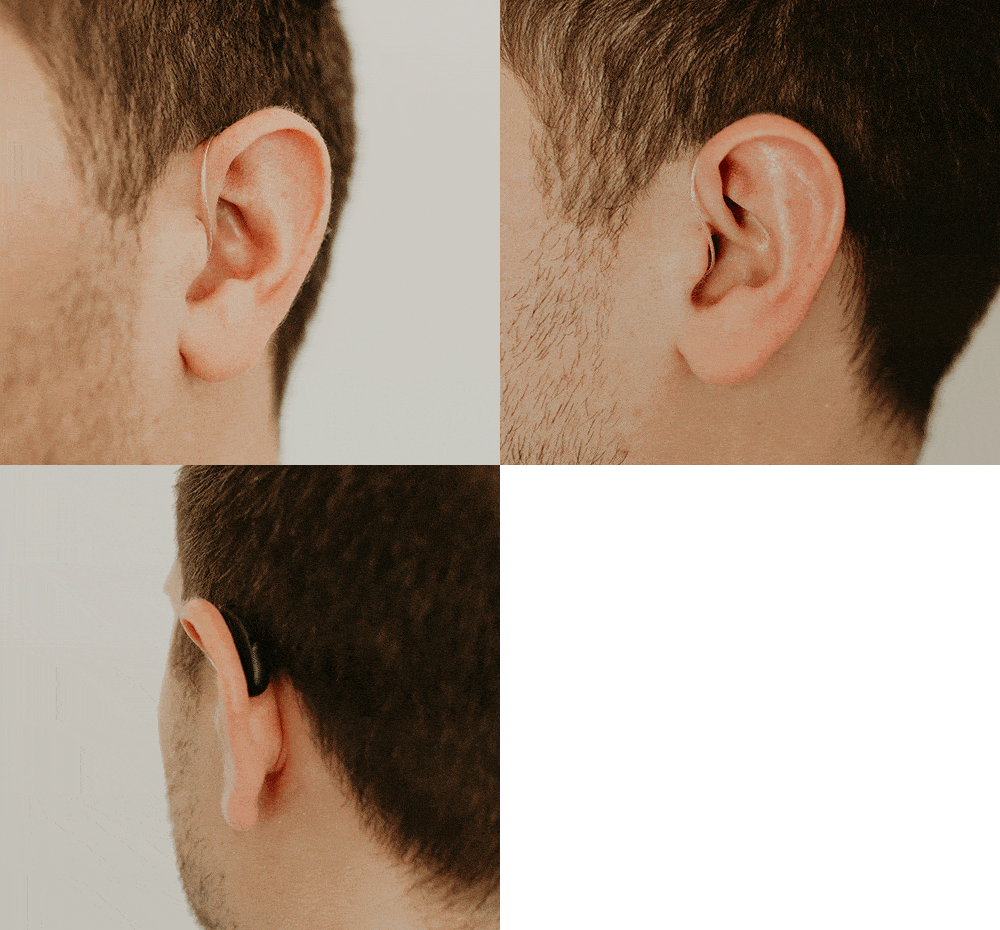
Behind-the-ear hearing aids rest behind the ear and send sound into the ear canal through a thin tube, a wire, or an earmold. They're typically more powerful and durable than in-ear models.
Receiver-in-canal (RIC) / receiver-in-the-ear (RITE)
RIC hearing aids are among the most popular styles today. The receiver (speaker) sits inside the ear canal, while the microphone and processor sit in a small case behind the ear. Separating them improves sound quality and reduces feedback. RIC devices often offer rechargeable batteries, smartphone apps, and features like directional microphones, noise reduction, and telecoils. Paired with open domes, they're a common choice for high-frequency hearing loss.
Audicus's RIC models include the Omni 3 ($1,898 a pair), the Omni 2 ($1,698 a pair), and the Ray ($1,998 a pair), which is designed for group conversations. Prices are as of November 2026.
BTE with earmold
This traditional BTE design delivers sound through a custom-fitted earmold. It's especially useful for severe-to-profound hearing loss, because it offers powerful amplification and holds up well. BTEs with earmolds are also common for children, since the earmold can be replaced as the child grows. They're not the most discreet option, but they're highly functional and dependable.
Specialty Hearing Devices
Some devices serve specific needs that standard hearing aids don't.
Hearing amplifiers (PSAPs)
Hearing amplifiers, also called personal sound amplification products (PSAPs), are not hearing aids. They boost sound for people without hearing loss in situations like birdwatching or lectures, and they aren't regulated as medical devices by the FDA. If you have hearing loss, an FDA-regulated OTC or prescription hearing aid is the right choice.
CROS and BiCROS hearing aids
CROS systems are designed for single-sided deafness. They pick up sound on the side that can't hear and send it to the better-hearing ear. BiCROS models also amplify sound for the better ear when it has some hearing loss too. Audiologists usually recommend these after specialized testing. Read more about choosing hearing aids for hearing loss in one ear.
Bone-anchored hearing aids (BAHAs)
BAHAs are usually surgically implanted and are used for conductive hearing loss, mixed hearing loss, or single-sided deafness. They send sound vibrations through the skull bone directly to the inner ear, bypassing damaged or non-functioning parts of the ear canal or middle ear. Some bone-conduction devices can also be worn without surgery on a soft headband, which is common for young children.
Which Hearing Aid Styles Can You Buy Over the Counter?
Since October 2022, adults 18 and older with perceived mild-to-moderate hearing loss can buy FDA-regulated OTC hearing aids without a prescription or exam. Most OTC hearing aids are RIC designs or small in-canal and earbud-style devices. Custom-molded ITE shells, power BTEs with earmolds, CROS systems, and bone-anchored devices are generally fitted by a hearing professional.
The rule's practical consequence: if your hearing loss is severe, or you have warning signs such as sudden hearing loss, hearing loss in only one ear, ear pain, drainage, or dizziness, start with an audiologist or doctor rather than an OTC device. Here's more on how OTC hearing aids work.
How to Choose the Right Type of Hearing Aid
Picking the right hearing aid involves more than your level of hearing loss. These questions will help narrow it down:
- How much hearing loss do you have? Mild-to-moderate loss opens up the smallest styles and OTC options; severe loss points to RIC or BTE styles with more power, fitted by a professional.
- How important is discretion? If you want the hearing aid hidden, look at IIC, CIC, or a small RIC.
- Do small parts give you trouble? If tiny buttons or batteries are hard to handle, choose a larger ITE, a RIC, or a rechargeable model with no batteries to change.
- Do you want to stream calls and music? Look for Bluetooth, which most RIC models include and many tiny in-canal models don't.
- Where is hearing hardest for you? Noisy restaurants and group conversations call for directional microphones and noise reduction; quiet one-on-one conversation is less demanding.
A licensed audiologist or hearing aid specialist can test your hearing, weigh these trade-offs with you, and recommend options that fit your life. For a convenient first step, take the Audicus online hearing test to get a preliminary read on your hearing profile. Our guide to which hearing aid is right for you goes deeper on choosing a model.
Match the style to your hearing loss first and your preferences second, and you'll end up with a hearing aid you actually wear.
Ready to compare models? See Audicus's OTC hearing aids side by side.
Related Resources
Frequently Asked Questions
What is the most discreet type of hearing aid?
The most discreet type of hearing aid is the invisible-in-canal (IIC) style. IIC hearing aids sit deep inside the ear canal and are nearly impossible to see. Completely-in-canal (CIC) models are a close second. Both are generally suited to mild-to-moderate hearing loss.
Which hearing aids are best for severe hearing loss?
For severe or profound hearing loss, behind-the-ear (BTE) hearing aids with custom earmolds and high-power amplification are usually recommended. Some RIC models with stronger receivers also work for severe loss. Severe hearing loss calls for a professional fitting rather than an OTC device.
Can I wear hearing aids with glasses?
Yes, you can wear hearing aids with glasses. Some behind-the-ear styles can feel crowded behind the ear alongside glasses arms. If that's uncomfortable, an in-the-ear or in-canal model avoids the issue, or your audiologist can suggest a slimmer fitting.
Do all hearing aids connect to smartphones?
Not all hearing aids connect to smartphones, but many modern models do. If Bluetooth matters to you, check that a model works with your phone: many now use universal Bluetooth that works with both iPhone and Android. Very small in-canal styles are the most likely to skip streaming.
How do I know which type of hearing aid is right for me?
The best way to know which type of hearing aid is right for you is to start with your hearing test results, then weigh discretion, dexterity, and the features you'll use. A hearing professional can assess your hearing and lifestyle and recommend models that fit; for mild-to-moderate loss, an online hearing test is a convenient first step.
How Hearing Aids Work: Technology & Styles
How Do Different Types of Hearing Aids Work
Understanding Your Hearing Aid's Parts and How They Work
Your Comprehensive Guide to Digital Hearing Aids
Making sense of the hearing aid lingo: what’s the difference between channels and bands… and how many do I need?
What is a Directional Microphone?
Programmable Hearing Aids