
This year’s Olympics in London was a truly mesmerizing event. It sure didn’t lack in drama, excitement, and broken records: Michael Phelps’ stash of swimming (gold) medals reached an all-time high and Usain Bolt’s Jamaican extravaganza certainly didn’t disappoint.
Throughout Olympic history, there were a few athletes who not only impressed the world with their athletic prowess but also for a very different reason: they didn’t let their hearing loss interfere with becoming an Olympian. Here is a short excerpt of these inspirational characters:

1. David Smith (USA, Volleyball)
Diagnosed with a 80-90% hearing loss, David has been wearing
hearing aids since the age of 3. David relies on a lot of lip-reading to communicate with his team and reports that his disability has resulted in him becoming a stronger athlete. He made his debut at the London Olympics 2012.

2. Tamika Catchings (USA, Basketball)
Tamika was born with a hearing deficiency in both ears and later developed a speech impediment. When she was young children teased her about her hearing and one day Tamika responded by throwing her hearing aid away.
Her parents refused to buy her a new one so they could teach her a lesson. Tamika only got stronger and increasingly impressive. In 2011 she got MVP in the WNBA and has won three consecutive Olympic gold medals (2004, 2008, and 2012).

3. Terrence Parkin (South Africa, Swimming)
In the 2000 Olympics in Sydney, Terrence surprised the world by winning the silver medal in the 200-meter breaststroke. While he communicates in sign language with his coach, strobe light signals are used during competition in order to indicate when to start swimming.

4. Chris Colwill (USA, Diving)
Two-time Olympian Chris Colwill was born with 60% hearing loss in both ears. He cannot wear his hearing aid when diving, he, therefore, relies on the scoreboard to know when it is his turn.

5. Marie Roethlisberger (USA, Gymnastics)
A 1984 alternate gymnast for the U.S. women’s team, Marie suffered hearing loss in one ear from birth and then in the other ear due to contracting meningitis during her childhood. Marie choreographed gymnastics routines to songs with heavy bass in order to feel the floor vibrations.

6. Tony Ally (GB, Diving)
Tony suffers from a genetic hearing loss since his early youth. When he was 16 he was happy to become a professional athlete and went on to win the European Championships in 1999 and take part in a total of 4 Olympic Games (1988, 1996, 2000, and 2004).

7. Frank Bartolillo (Australia, Fencing)
In the 2004 Olympics in Athens, Bartolillo competed in the individual foil event as the top Australian fencer. He claimed that being deaf was an advantage as it enabled him to better concentrate.

8. Jeff Float (USA, Swimming)
Float was the first deaf swimmer to win a gold medal when the U.S. won the 4x200-meter freestyle relay at the 1984 Los Angeles
Olympics.
When he emerged from the pool after swimming the third leg of the relay and shattering the world record by five seconds, he heard the roar of the hometown crowd and said: “It was the first time I remember distinctively hearing loud cheers at a meet.”
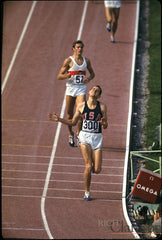
9. Jim Ryun (USA, Track and Field)
Ryun was a silver medalist in the 1,500m race in the 1968 Mexico City Olympics. He later became a Republican congressman serving the 2
nd district of Kansas from 1996-2007 and was responsible for introducing the Hearing Aid Tax Credit Act.
If you are suffering from hearing loss, these 9 athletes may serve as an example of the Olympics motto of “The Games Must Go On”. On that note, discreet digital hearing aids and
personal sound amplifiers might be a solution that Audicus is more than happy to assist you with.
Sources: Sports World Report, Arnold Hearing, Wikipedia, Audicus Hearing Aids, Tom Theobald, ASHA, Wired, Top End Sports, SMH, Rich Clarkson, GN Resound
by Seema Vikram Shukla
Test Your Hearing For Free


