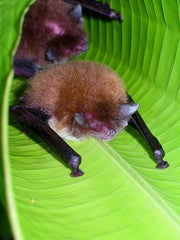
Researchers from the Universidad de Costa Rica and North Dakota State University have discovered that the Spix's disk-winged bat, native to Central and South America, uses leaves to communicate with and pinpoint members of its social group: a natural hearing aid.
Nature's Hearing Aids: The Old and the New
It’s no surprise that bats rely heavily on their sense of hearing. Several bat species live in dark environments like caves, where it's nearly impossible to see. Plus, bats only come out at night to feed. They use
echolocation, which involves making clicking noises that bounce off of objects and return back, which gives bats information about their whereabouts. Bats use this ability to navigate around obstacles, as well as for mating and finding food.
Surprisingly, bats can also use tools from the environment to increase their hearing capabilities. Professor Gloriana Chaverri of the Universidad de Costa Rica and Professor Erin H. Gillam from North Dakota State University have discovered that a particular species of bat called the Spix's disk-winged bat, named for its unique disks in its thumbs and feet, uses leaves like an acoustic horn to magnify the sound of incoming and outgoing social calls. It's the first animal ever observed to use a horn-shaped object as a tool for sound manipulation, like an innovative form of
hearing aid.
The Findings on this Naturally-Occurring Hearing Aid
The
Spix's disk-winged bat has suction cups on its thumbs and hind feet that allow it to cling to smooth surfaces, making the bat look more like a fuzzy refrigerator magnet than a terror of the night. Flying bats make calls to maintain contact with group members and roosting bats respond by making calls of their own. This behavior ensures that group members will not become separated after moving to different roosts throughout the day.
Researchers found that both inquiry and response calls become louder when bats use leaves, but response calls in particular only increase by a mere 1 or 2 decibels (which isn't much); to put things into perspective, humans can't even hear sounds below
3 decibels. Although leaves are primitive in comparison to
new models of hearing technology and
hearing aids already in development, such an amazing discovery provides further insight into the hidden intelligence of
animals.
by Aaron Rodriques


