This guest post was contributed by Ed Belcher*, who put together this eye-opening, neat piece of analysis.
Did you ever wonder why a hearing aid can cost up to 6x more than an iPad? Peeling the onion on the cost structure of both devices reveals an eye-opening comparison into the dynamics of either industry. It can provide us with pointers on where the future price and cost tags could shift and should.
Let’s assume a high-end hearing aid costs $1000 to the audiologist when he/she buys it from the manufacturer and consequently gets sold for $3000 to the consumer. Now if you dissect the $1000, based on a study by the German Competition Regulator, the following total cost breakdown emerges:
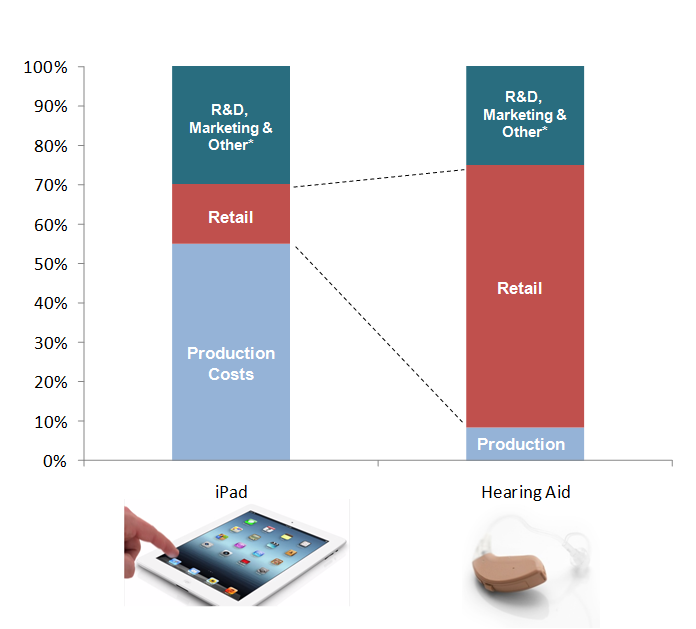
Now, let’s take a closer look at the iPad: a recent study at the University of California, Irvine took a closer look at the cost structure of a regular iPad and came up with the following segmentation:
The manufacturing and distribution costs of a hearing aid are upside-down in comparison to the manufacturing and distribution costs of an iPad.
The iPad is subject to hard, unfettered competition. Its manufacturer profit, marketing, R&D and dispensing costs combined take up 45% of the retail price. The production cost takes the balance (55%) of the retail price.
Most hearing aids are made by the Big-6 consortium which shares patents and does business in a mutually beneficial way. The dispensing businesses sell the aids at a price around 3x their wholesale cost. In that case, the production cost of a hearing aid comprises only 8% of its bundled price. The remaining 92% is made up mostly of dispensing fees, administration salaries, and profits.
Granted, the market structure is different for both products. For instance, the sheer sales volumes of iPads far surpass those of hearing aids: Apple sold 3Mn iPads in the first 72 hours of its recent launch. By contrast, 3Mn units are what the entire hearing aids industry sells in one year. This sales volume allows for different economies of scale, especially when it comes to retail.
Furthermore there is a more involved service component attached to hearing aid dispensing (however not as much as what is traditionally claimed). Hearing aid dispensing, based on personal experiences when shopping in varied businesses for hearing aids, took 1 hour for the exam and discussion of HA options; 1 hour for fitting and training; and up to 2 hours for up to four 30-minute adjustments/training, a total of 4 hours of contact time. Assuming $100 per hour, consultation should yield a total of $400 in dispensing service fees.
In any case, the comparison is still startling and should raise questions on whether the industry is really operating at its most favorable level for the consumer. Let’s look at the next piece of analysis.
The aforementioned hearing aid that a dispenser buys for $1000 costs about $250 to make, as we saw with the previous example. So we start with the $250 production cost.
If the iPad-structure were followed based on the $250 production cost (i.e. 55% of the total) then:
- the final retail price for one hearing aid would be $250 / 0.55 = $455
- If the specialist sells two aids for $455 each and adds $400 for four hours of service, a pair of high-end hearing aids would have a price of $1,310
Let’s pause here and put this figure into perspective: $1,310 is equivalent to 22% of the traditional $6000 for the same pair!
What does this calculation imply on the audiologist revenues per customer? The $455 retail price includes a 15% markup (same as the iPad) of $68.25/aid. The total proceeds to the dispenser is 2*$68.25 + $400 = $537 for each customer served.
The questions that remain are thus:
Tell us what you think; we would love to hear your opinion!
______________________________________________
* Ph.D. EE, Career researcher (retired) in underwater acoustics at the University of Washington
Sources: German Competition Regulator, The Economist, MSN Money, Lucille Beck, Director of Audiology, VA, The Hill
Ear by Ear: Innovative Hearing Aids for the Developing World →
← Five Easy Steps to Healthy Hearing
I purchased my first pair of hearing aids several months ago. Upon analyzing the bill, I found it to be the biggest rip-off I’ve ever experienced. The dispensing fee is outright robbery and this fee was not explained up-front.
The procedure of buying hearing aids is not like buying shoes, or other things which you can try before you buy, due to the fact that you can’t just try them on off the shelf. Shopping around is difficult as the various features and terminology describing different brands becomes confusing as they all seem to have different terms for similar features which makes them more difficult to compare. Collusion seems evident given the hearing aid cost and the dispensing fee rip-off.
Someone should open a chain of stores selling hearing aids using the structure in the article and advertise the cost analysis. I’d go there – who wouldn’t?
As for adjusting hearing aids, surely there is a program which could be installed on a PC to allow the user to tune the aids him/herself. ???
Online purchase of hearing aids? I need to replace my first set of hearing aids. I love your blog and the great information. I understand that one can purchase them online. Any help, cautions, experience?
Hi,
I am a Musician.I can purchase the very best Brand amplifier and a hand made exquisite guitar for less than the price of two of these hearing aids.The guitar and amp. will last a lifetime with a little tlc.I can prove this as I have two that I purchased in 1962 and they still work perfectly and are now valued at 40000 dollars,I kid you not.
Hearing aids are a total rip off.They should be priced at just a couple of hundred Bucks/Euro/Stg.I need aids big time but not enough to pay these silly prices.
These people will keep selling these aids at these prices as long as people are foolish enough to buy them.
We are being ripped off .Hearing aids should only be dispensed by qualified health workers
who’s best interests are the health of the patient.
Many comments from dispensers argue that hearing aids are expensive because of their cost to dispense. In my blog
http://hearingaidsunveiled.blogspot.com/
third entry down, dated Oct 2, 2012, and titled “Dispensing – Profit versus Quantity and Efficiency,” I consider the expenses of dispensing. I present a hypothetical retail franchise that does very well for its employees and owners as well as provides excellent service and premium products to its customers at prices between 25% and 50% currently charged by private practices.
The comments here are diverse and interesting. However, my experience having gone to Sam’s club is that the top and hearing instrument, Which cost $4000 for hair with four year warranty, is a good deal compared what you can get that and audiologists that his having to work in a high Overhead office.
I came away thinking it was pretty ridiculous to purchase a device that was no more expensive to produce than a flip cell phone. Even with Sam’s providing the overhead support for the audiologist and the advantage of in-store advertising to people walking by, the price was still way too high for the product.
It will take more than Sam’s and Costco to break the current model of overpriced hearing devices. A device that is manufactured outside of the current cartel would be free to provide technology that is driven by demand and not the needs of those controlling the market a monopoly.
Because there is a huge market that is not being exploited, I believe there is little doubt that there will be a dramatic change in the way that hearing instruments are produced distributed et cetera. One example would be the Bluetooth capable hearing instrument that could be completely operated and calibrated by an application that would run on your iPhone iPad or other smart device. There was nothing that the audiologist at the Sam’s Club where I had my appointment did that could not be done by using an application, iPad, and Bluetooth conection… To calibrate and adjust the instrument. The remaining support issues would not require an audiologist trained technician.
The bottom line, I expect that the whole model for selling hearing nstruments will change dramatically in the coming years. Obviously people that need hearing instraments are mostly in there 50s and up. As the younger generation’s approach the time when they may need an assist, they will not accept the ridiculous price structure that is currently in place due to industry and regulatory structures defining all aids as medical devices. Self programmable devices need not fall under the category of medical instruments.
With all the above said, there is still no need for audiologists to be left out of the circuit so to speak. The insurance industry’s legitimate role of covering specialized professional audiology services would enhance those professions by restructuring the compensation model away from the reliance upon the sale of hearing devices.
Is it just me or do others find it hysterical that people are typing in all caps on a hearing aid forum.
I am aghast that audiologists are defending the price of hearing aids by the small number they sell. Does it occur to anyone that they sell a small number because they are so expensive? Apparently no one discusses market dynamics in audiology school.
My mother is 95 and needs new hearing aids. She can hear OK but not as well as she could with new hearing aids. This has been going on for a few years now. She knows that new ones are a minimum $4000 and her attitude is that she hangs around with old people and they have nothing interesting to say anyway.
The point is that she would have replaced them twice in the last four years if she was not being gouged, but she says no, don’t waste the money.
I find the price to be a total rip-off. First of all why incorporate the cost of research into the market price? Research is the cost of doing business. Suck it up. I can buy a head set with noise suppression and automatic gain control for less than $100. A sophisticated notebook computer costs me a lot less than a cheap hearing aid. I have worked in electronics since the days of vaccuume tubes and making mini parts is not expensive these days so don’t say small size is the big cost.They have cameras the size of pin heads these days for $100. Hearing aids are a rip because theyare controled by the market. They have a market with no competition and customers with no other choice. If you can’t make a profit then you boost sales, boosting sales is done by reducing prices and getting rid of your three BMW’s.
Thank you very much for sharing. It is great for people to know and understand the breakdown of why a hearing aid costs so much. I think that this will help people be more understanding when buying a hearing aid. It is a great investment and will be worth the money. – Hearing Aids Colorado
I see the point of this article but as some other have said here, it doesn’t show the full picture. It looks like middleman is just a greedy guy for charging those prices.
I live in Europe but i’m guessing this isn’t going to be much different.
- I have to pay a rent (workplace not living place)
- I have to pay for water
- I have to pay for light
- I have to pay for security
- I have to pay an insurance
- I have to pay my employees
- I have to pay my own advertising and marketing (And the marketing & advertising cost of the manufacturer based on this article, why do i buy it for 1000 and not 250 which is the production cost then?)
- I have paid all my equipment to properly do audiometries
- And for the rest of the comfortable place i want you to visit so you will stay
- I have paid my studies to be an audiologist
- And i need to keep myself in constant formation of new tech, discoveries, articles, etc…
- I’m investing time with the customer before and after the deal
- I have to pay taxes for working, for having a worplace, for being an audiologist, etc etc etc
- I´m sure i forget something
So there you have my costs after i bought that hearing aid for 1000. Indeed the middleman is costly but it’s also there to get your problems fixed (at a cost or not) and much more accesible.
Cost is not he number one reason people do not purchase hearing aids.
It ranks as number seven.
One person commented it is because of greed that prices are so high.
You need to walk in my shoes for a year and then you might understand how foolish that
statement is.
With operating expenses of $8,000.00 per month, not including my income of $30,000.00 per year, i need to sell 12 units per month to keep the doors open. All last summer i sold 3 or 4 units per month. Just got a tax bill from my county for $800.00
No longer sure i will servive in this business. I have been here in business in this area for over 25 years. Still working and trying to earn a living at 72 years old.
Maybe i should give up, join Obama’s followers and go on welfare, and food stamps.
I am far from getting rich selling hearing aids, and i am tired of working.
Like i said…… try doing the job for a year, then tell me how greedy i am.
I am a senior of 71 years of age with hearing loss for the last 30 years or so. My income hinders me from buying hearing aids because the price is considered by me as one of the biggest rip-offs together with gas prices, glasses, dentists…
My hearing is getting worst to the point of having to abandon my only past time of singing in a choir.
If I had my way…
Interesting, amusing, part good point part not.
Let me say a couple of things
First, I am a qualified hearing aid audiologist so I do want earn more than an iPad retail geek. But more importantly you quote for a $250 hearing aid and then call it top end which is not correct. A low end hearing aid would cost that. A top end aid, to me is £600-£700 approx, plus vat. Convert that to dollars then redo your sums. Oh and I reckon over 5-10 years it’s an hour a year at least with each client. I’m interested to know how your revised sums look.
To those who are disappointed with your hearing aids please remember… Your hearing is damaged and a hearing aid is not curing the problem so can only work as well as the ear responds. In the uk we give a money back guarantee so no one has to buy an aid they are not happy with.
I AM 69 Y/O. I HAD MY STAPEDIUS REPLCED AT NY EYE&EAR INFIRMARY 35 YRS AGO . I KNOW MY HEARING IS LESS ON MY LEFT SIDE, I CAN STILL FUNCTION WELL , AT
TIMES MY COLLEAGUES AND OFFICE EMPLOYEES TELL ME THAT I WILL HEAR WHAT I WANT TO HEAR AND OTHERTIMES I IGNORE THEM. BUT I KNOW I DO HAVE SLIGHT LOSS OF HEARING. I COME TO HOBOKEN ALMOST EVERY DAY AND I WAS HAPPY TO SEE YOUR ADDRESS IS IN HOBOKEN. I WILL LIKE TO TRY YOUR CIC UNIT, BUT I HAVE TO BUILD UP THE COURAGE TO DO IT.
WHAT I READ ALL ABOUT HEARING AIDS IS VERY WELL WRITTEN AT YOUR WEB SITE.
YOU ARE DOING A GREAT SERVICE TO YOUR CLIENTS.
I WISH THAT ALL THE PEOPLE WITH HEARING LOSS SHOULD COME TO KNOW ABOUT YOUR SERVICE.
I WSH YOU THE BEST,
RAJA RAHULA MD
HEARING AIDS ONE BIG RIPOFF.IHAVE A CELL PHONE I CAN
TALK TO MY GRANDSON IN NEPAL IT COST 60 BUCKS
MY HEARING AIDS COST 3500 CANT HEAR ACCROSS THE ROOM WHY NO REAON
I am now on my second set of top brand hearing aids. Neither has been
satisfactory in delivering the quality of sound that the extreme cost should provide. I’m sick of Mickey Mouse voices, whistling, plus beeps of battery failure. I,m sick of these expensive devices falling of my smaller than a man’s ears. I’m sick of having to put my glasses on to install batteries. I’ve lost two aids forever because they do disconnect from your ears without notice and with insurance you still get dinged with deductions. My current audiologist has charged me $200 for initial installation and brief follow up and I am getting muffled sound in one ear.
I can’t believe, in this scientific age , that hearing aids can be made better
and for less and with better, convenient design, especially for women.
I think if aids were more efficient, better designs, and less costly more of us need of them would rush to the market place. My experience leads me to feel hearings are a scam. Now that I am far into retirement I can’t afford this expensive help and will soon be isolated from normal activities in my community. In the next world, I’ll learn lip reading early in life so I’ll be ready for weary ears.
Price is our biggest barrier. I’ve put off for years dealing with my hearing loss because our insurance doesn’t cover any part of hearing aids. Now my 15yr old daughter needs them due to a genetic disorder (not from listening to loud music!) and we’re afraid we won’t be able to get them for her due to the prices! Price is definately a barrier!!!!
Excellent article/post. Let me add a couple points:
1. One critical difference in your analysis that you didn’t go into is the level of training/licensing/education in the “retail” end of the hearing aid business. Because hearing aids are classified as medical devices, the persons allowed to distribute hearing aids has been carefully controlled by state licensing boards, which are controlled by current practitioners. This creates limited number of outlets for the distribution of hearing aids “safely” to the public.
2. The creation of the AuD degree for audiologists was a move to raise the level of professionalism in the dispensing of hearing aids as well as improve the professional standing of audiologists among other health care providers by making it a “doctoring” degree. At the same time it increased the income expectation of those audiologists.
3. Your “retail” section of analysis ignores the business operating costs of the audiologists and hearing aid dispensers. The advertising/marketing costs you show are for those of the manufacturer only. The retailer must also advertise and the costs are a significant portion of the retail cost of the product. Further you are ignoring the rent, administrative costs and other operating expenses of the retail practitioner which have to come out of their “retail” portion. It is not all “profit.”
Simply lowering the price of hearing aids will not create more demand as Scott explains. Retailers would be the ones who would have to bear the risk of reducing their margins in order to generate the “expected” revenue and the market is littered with the bones of businesses who thought that they could accomplish the necessary volume/price tradeoff only to find that the market didn’t reward them sufficiently for their dramatic price reductions.
There may be some movement in the future to sell hearing aids more “directly” to consumers or with minimal professional involvement, like United Health Cares abortive attempt earlier this year, but you can count on the established interests of audiologists and hearing aid dispensers to oppose any threats to their “license” to sell hearing aids.
I am one of the many who suffers from severe hearing loss but cannot afford the ridiculous high price of decent hearing aids. I am only 33 and have suffered hearing problems since primary school. I have previously undertaken free trials only to learn I cannot afford the actual purchase (being over $5000 for the pair). Now, this sucks in ways that the hearing aid companies may not realise. The main concern for me is the extreme difficulty I have in the workplace. I was (until a few years ago) an award winning chef, with bucket loads of potential and intelligence, and for years have been extremely passionate about beginning a career in counselling and psychology. To begin my career, in 2006 I began a double degree in social work and human services only to learn I couldn’t understand my lecturers! I left the course out of frustration and instead joined a concreting crew so I could be in a job surrounded by loud blokes who never use big words which makes them easy to understand. As far as I can see, this country is missing out on many people with passion and potential due to its unhealthy love affair with capitalising on peoples unfortunate circumstances. Shame on you, audiology
“companies”!! And don’t get me started on dentistry…
I am an audiologist (wearing body armour so the inevitable rock throwing won’t cause permanent damage) and would like to make one comment related to barriers to hearing aid use. We still don’t understand why people will not accept hearing aids. Price, stigma, appearance are relevant but there are other unknowns. The Better Hearing Institute did a survey several years ago and asked hearing impaired people who were not hearing aid users this one question: If you could have hearing aids for free that were invisible and that would solve your hearing problems, would you wear them? 62% said yes but a full 38% said No!! With this scenario we address cost (free), we address cosmetic concerns (hidden), and we assure benefit – and yet 35% still didn’t want hearing aids. Why? What is the X factor that we still don’t understand? I don’t know but it points to the problem being more complex than we currently understand. That said, 62% penetration is much better than the 20% we’re at right now.
Thanks for all the input everyone!
@Ramon: thanks for the comment! the traditional channels come with a lot of face time and servicing that ultimately finds its way into a bundled, final hearing aid price. This variant might work for a lot of people… but there has to be more choice for those that can’t afford it.
@Mike: price is most certainly the #1 reason, followed by stigma and aesthetics. Currently there is still a lot of inertia for people to shop around and become informed about there being more affordable alternatives available… which is why you won’t see an immediate increase in volume because of a price drop. The minute there is more price transparency, prices will be impacted.
@Harold: thanks! we’re very much looking forward to your launch!
@Mae: great comment, lets get the word out and let people know that there are viable alternatives out there.
Great article and with professionl documentation. I have purchased a couple of hearing aids when my wife and were working, One lasted 4 years. The ones I have now are beyond repairs and both sets were $5,000. Now I am in neeed of hearing aids but do not have the resources to pay those kind of prices.
I moved to another states and tried to get audiologist to adjust the hearing aids and most refused, because I had not purchased from them. I found a couple of audiologist later on and they charged me $100, which I was gladly wiling to pay, Except both were not trained by the company that made my hearing aids, so they never ot them right.
I ran unto a friend who used to work for a major hearing aid company and he told me the similar information that you stated and I was in schock.
Recently I posted in a hearing aid blog about what my friend told me of what is the actual cost of hearing aids and it seems people don’t believed it.
There is such a thing as profit, I can understand that, but when you have a business that have the market corner and in a sense have people that are in need of medical devices hostage to the outrageous prices, in my opinion , It is not free market or making a decent profit, it is as they said in the vernacular " highway robbery, or out of control greed".
What I like to hear is what can consumers do to get these companies to be more compassionate and ethical in their pricing of hearing aids, you quoted 28 million people that need these medical devices that they can’t afford. People will continue to sacrifice and buy hearing aids even with high prices, because they have no choice, without them, your whole life is affected.
Awesome post. Not only would hearing aids sell but the increase in sales would be exponential. What is the number one reason for NOT getting hearing aids? I’m not an expert but I’m going to go with cost.
Patrick:
Great blog, excellent information. We at Audiotoniq, Inc. support you in your efforts to bring this very important issue to the forefront!
Great Article. Having worked in NYC Advertising for a number of years I can truthfully say if people willingly pay high prices for hearing aids, high prices will continue to be charged. It is obscene. Only when folks stop paying through the proverbial, will the price drop. You just have to get the word out that you don’t have to support highway robbery. Individual dispensors as well as HMO’s are equally at fault.
Thank you.
mike thornton
June 12, 2013
Okay, I live in Germany. I bought a pair of aids 8 years ago for 3000 euros the pair. You suggest that the audiologist got 2000 euros. Or 250 euros per year. For that I got about 3 hours’ worth of initial advice and initial fine-tuning, plus a free cleaning service as often as I need it, usually about once every nine months. And two hearing checks since. No one else can do these things. I find it cheap at the price. My ENT doctor charges 60 euros just to syringe my ears, and that’s pure routine. That’s a rip-off for you — a quarter of what the audiologists gets, for a five-minute procedure.